Ball Harambee by Basil Wilson
Kevin Prince Boateng, a star player for A.C. Milan’s Soccer Team, playing in
a friendly, was so incensed by the racial taunts coming from a section of fans from
the opposing team, that he kicked the ball in the stands and walked off the field.
His fellow teammates supported his protest and also walked off the field. The
friendly soccer match ended prematurely. The incident graphically illustrates the
persistence of vulgar racism in professional soccer in Europe.

The highly competitive soccer leagues in Europe, particularly the English
Premier League, the Bundesliga in Germany, La Liga in Spain and Serie A in Italy
attract the best soccer players in the world. The top clubs, Chelsea, Manchester
City, Manchester United, Arsenal, Tottenham (EPL), Real Madrid and Barcelona
(La Liga), Bayern Munich (Bundesliga) and A.C. Milan, Juventus and Inter Milan
(Serie A) are owned by wealthy entrepreneurs who are willing to spend lavishly
on attracting to their clubs the super-stars in the game. The drive to procure
silver transcends homogeneity and the top clubs have become racially and
ethnically diverse. As an example, the A.C. Milan team includes many top Italian
players but also Brazilians, Africans and Europeans of mixed heritage.
Soccer is the most globalized sports and in recent decades, the top teams
have become stunningly diverse. The soccer world body, FIFA, has sought to
stage the World Cup held every four years in places outside of Western Europe.
In 2010, the World Cup was staged in South Africa. In 2014, it will be held in
Brazil and in 2018 the World Cup will be staged in Russia.
The violent racism among fans is unsurprisingly concentrated in Eastern
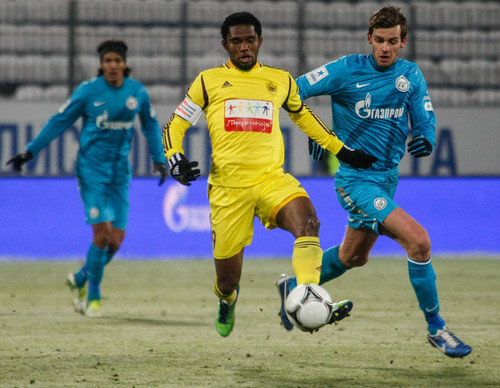
Europe and Russia. The Russian team in St. Petersburg, Zenit, fans recently
demanded that the club not sign to the team black players or homosexuals.
Paradoxically, Zenit recently signed for a lot of money the Brazilian forward
known as “Hulk” who has gotten the cold treatment from his fellow Russian teammates.
Samuel Eto’o, the Cameroon striker and the highest paid soccer player in
the world, was given a $28 million annual contract for three years by a Russian
club, Anzhi, that is based in Moscow but plays matches in Dagestan. What we
are seeing unfold in Russia is the clash of the billionaires’ urge to win versus the
traditional culture of racism.
In the summer of 2012, the European cup was held betwixt Poland and
Ukraine. The Ukraine and Poland and much of Eastern Europe are plagued with a
persistent residue of fascism and racism. In the post-communist era the fascism
that was previously repressed is now coming to the fore and many of these fans
attend games giving fascist salutes, engaging in racial taunts and throwing banana
skin on the playing surface.
Prior to the staging of the European Cup in the summer of 2012, there were
more than a couple of nasty incidents involving racist fans and black players. The
English full back, Danny Rose, was pelted with flying objects while representing
England in an under 21 match against the Serbian national under 21 team. What
was shameful about the incident is that the Serbian Football Federation failed to take disciplinary action.
The racial incidents were kept under control in the European Cup of 2012.
There have been associations like Never Again, established to stamp out racism in
soccer. But the incident recently in Italy involving Kevin Boateng, a Ghanaian and
also of German heritage, underscores the difficulty that Europe is having in
dealing with the forces of racism. Italy was a hotbed of fascism in the 1930s and
the Mussolinic tendencies have not disappeared.
In England, recent incidents have not involved fans per se but players. The
Football Association has adopted a policy of zero tolerance vis-à-vis racism.
Anton Ferdinand, a defender at Queens Park Rangers in the EPL, accused John
Terry, the Chelsea captain, of racial taunts after a match in the early part of the
2012-2013 season. Terry was suspended for a few games. Also, Luis Suarez, the
Uruguayan playing for Liverpool was brought before the FA Disciplinary Board and
suspended for 8 matches for his racial taunts directed at Patrice Evra, the black
Frenchman and captain at Manchester United.
In another couple of weeks in the United States, the National Football
League will stage the Super-Bowl. American professional sports have come a long
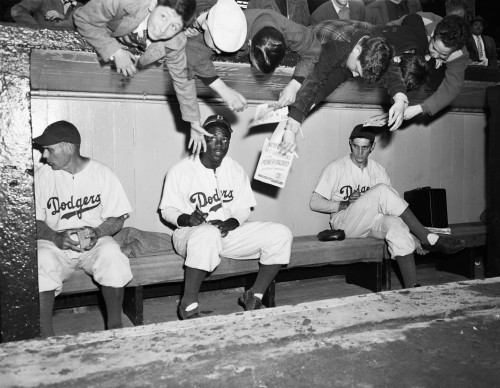
way from the post-World War 2 years when Jackie Robinson broke the color bar.
Playing for the Brooklyn Dodgers, Jackie Robinson, for the first couple of years,
had to endure vicious racial taunts.
There was a time in American football when blacks were not given the
opportunity to compete as quarterbacks. American professional sports, baseball,
football, basketball, are in more of an advanced stage than Europe. Racism in
some form still exists but fans, irrespective of their hue, come to cheer their
heroes irrespective of their race. Those professional teams are now highly integrated.
Western Europe is certainly more advanced than the United States in terms
of health care, alleviating poverty, coping with unemployment, upward mobility
and equality but on matters of race in professional sports, the United States has
become comfortable with racial and ethnic diversity and has moved beyond the Jackie Robinson era.
Europe is still struggling with its fascist and racist atavisms. Despite the
globalized nature of professional soccer, there is still a lot of enlightening that
must be undertaken to bring Europe into the new world of diversity.