Showing posts with label selecao. Show all posts

Monday, September 9, 2013

Brazil Fine Tunes, Australia Out of Tune

Ball Harambee By Bagga Wilks


Australia is more known for its cricket prowess than its soccer skills. In a friendly against Brazil in Brazil, it was batting practice for the Selecao squad. At the end of a ninety minute rout, Brazil had registered six goals. Australia early in the game had a few corners but barely had a shot on goal.


Scolari’s team did not play well against Switzerland in a recent friendly when they lost 1-0 with Daniel Alves scoring on his own keeper. The Brazilians are yet to show that they can win on the road. They were impressive in the Confederation Cup which was played in their backyard. But does the dog have the same bark when he walks through the gate and leaves the confines of his own house? Brazil plays Portugal on Tuesday, September 10 in Boston and that will be a more formidable test for Scolari’s squad.


Scolari experimented with his starting team against Australia. Maicon who spent a half season warming Manchester City’s bench and is now at Roma, started at right full back. The two central defenders, Thiago Silva and David Luiz have grown comfortable playing together. Marcelo started at left full back but had to leave the game just before half-time as he pulled a hamstring. Brazil is unquestionably solid with their back.
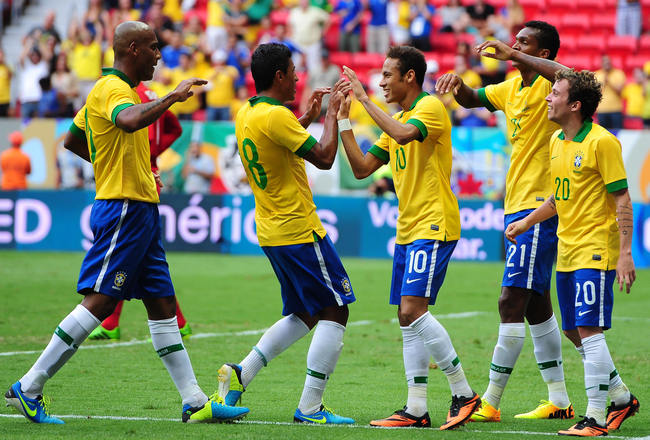


Oscar was injured and thus the three mid-field players were Luiz Gustavo, Paulinho and Ramires. Those are three mid-fielders who can run until the cows come home, tackle furiously and are effective offensive players. Scolari should stick with that trio against Portugal.


Against Australia, there was no Hulk and the talented Bernard started on the right flank and made quite an impression. Scolari will have to keep Bernard in the starting line-up.


Jo replaced Fred and netted two goals. Jo had a rough time in his debut in English soccer with Manchester City and was shopped around from club to club. He returned to Brazil and has re-established himself as a formidable striker and more than likely will start for Brazil in the 2014 World Cup.


The strike force of Neymar, Jo and Bernard will not be easily contained by opposing defenders. The midfield will be supportive of the forwards and the last four comprise some of the top defenders in the world of soccer.


Scolari is fine tuning his squad and the aggregation is being led by players in their early twenties seeking to bring back the glory days of Brazilian soccer.

Tuesday, July 23, 2013

Whither Ronaldinho, Robinho and Kaka

Ball Harambee By Bagga Wilks


Paul Vickery who is one of the better soccer pundits published a piece on ESPN soccer stating that the Brazilian coach, Scolari, has indicated that 80 percent of the Brazilian team for the World Cup 2014 has already been selected. Based on the success of the Confederation Cup, I doubt if Scolari will tinker with his starting eleven or the bench. Scolari has a lot to do with accelerating the work rate of every member of the squad. The forwards are expected to fall back and defend. The mid-field players and full backs are expected to join in the attack. It’s a full court press for ninety minutes and especially in the final with Spain, Brazil out-hustled, out-muscled the Spaniards.


The pre-Scolari teams tended to play too slow, were too tardy and lacked intensity. That is anti-thetical modern football. Like the workers of the world, international players must have a high rate of productivity. Unlike the workers of the world, the professional soccer players are well paid.


Does that mean there is no hope for Ronaldinho, Robinho or Kaka?


Ronaldinho has recovered some form since returning to Brazil and has taken his team, Atletico Mineiro, to the final of Copa Libertadores. But at 33 can Ronaldinho play on two sides of the ball? He certainly is capable of defense splitting passes but for Scolari that might not be enough.


Robinho has fallen off a cliff. A.C. Milan was negotiating a transfer to Santos of Brazil but the transfer negotiations have broken down. Robinho doesn’t seem to be in the plans of A.C. Milan and his hefty salary of 4 million pounds makes it a chore for another club to give the once Brazilian star an opportunity to play on a regular basis.


Kaka’s career also plummeted once moving to Real Madrid. Plagued by injuries and the garguantun footprints of Ronaldo, Mourinho kept him in the shadows. With the advent of Ancellotti, Kaka hopes that he will be given more playing time. Whether that will mean space on the Brazilian national team, that will not be an easy task.


Scolari’s message is that Brazil has entered a new age and the stars of yesteryear must be confined to the history books.

Monday, June 24, 2013

Neymar Dazzles and the Movement Mushrooms

Ball Harambee By Bagga Wilks


Neymar has ignited Brazil and his spectacular performance thus far in the Confederation Cup has been instrumental in Brazil getting to the semi-final where they will likely play Uruguay. The other semi-finalists will be Spain and Italy and that sets up a Brazil vs Spain final to conclude the Confederation Cup, the precursor to the World Cup to be held in Brazil in 2014.


As Neymar and his compatriots dazzle on the field, the protest movement of millions of Brazilians is sending a clear message to the government that expenditures on stadiums should not come at the expense of people’s lives. The government inastutely raised the cost of mass transportation and the protest movement has forced a rollback in those price increases. To stem the rising tide, the President of Brazil in an address to the nation has promised greater expenditures on health and education. The government’s belated wakeup call might not be sufficient to stem the mushrooming unrest.


Scolari’s squad has been triumphant playing at home and even though Neymar has come of age in the tournament, the Brazilian World Cup team has a long road to travel to return to the top of the heap in world soccer. The back four of Daniel Alves, Thiago Silva, David Luiz and Marcelo were impregnable until David Luiz in the Italy game had to leave the field injured. Dante, the Bayern Munich central defender does not cover as much ground as David Luiz and the two goals by Italy were scored when he replaced David Luiz.


With Marcelo, Scolari has a dilemma. Marcelo has great offensive skills as a left fall back and combines well with Neymar. But on counter-attacks, he leaves gaping holes in the Brazilian left flank. One of the defensive mid-fielders will have to plug that hole.


Against Italy, Scolari brought in Hermanes for the injured Paulinho. Hernanes has played well for Lazio in Serie A but he is yet to show up while representing the national team. Against Italy he was missing in action. Fred, as a striker, displayed his attributes against Italy but Hulk is yet to impress. Oscar played for Brazil in the 2012 Olympics, then joined Chelsea for the 2012-2013 EPL season and is now playing in the Confederation Cup. He has not been effective as Oscar must be in need of a rest.


Scolari made a grave mistake by not selecting Ramires who like Paulinho can run up and down the pitch until the cows come home. Scolari’s Brazilian national team still needs some tinkering and will be truly tested if they play Spain, the World Cup defenders, in the final of the Confederation Cup.


Neymar and most of the Brazilian squad have come out in support of the widespread demonstrations. The Confederation Cup represents Neymar’s showcasing his talent on the world stage. In the fall, he will join the great Messi in Barcelona. The two together will produce for the years to come highlight reels that will be immortalized on YouTube for the ages.

Tuesday, June 11, 2013

Scolari’s Redemption

Ball Harambee By Bagga Wilks


One swallow does not make a summer. Brazil’s 3-0 victory over France in a friendly played at home breaks the cycle of poor performances since Scolari replaced Mano Menezes as the coach of the Brazilian national team. The victory against France gives Scolari a temporary reprieve but the real test of the Brazilian national squad’s capabilities will come at the Confederation Cup that begins June 15 and runs until June 30.

Brazil is the host country for the World Cup in 2014 and the national aspiration is to return Brazilian football to its glory days by winning its sixth lien on the World Cup.


Brazil last won the World Cup in 2002. That team with Ronaldinho, Ronaldo, Rivaldo, Cafu and Roberto Carlos trounced the rest of the world. Since 2002, the Brazilian national team has stumbled and in the present FIFA ranking is at the country’s lowest, placed at 22.

In 2006, France with the aging Zidane, Henry and Patrick Veira knocked out Brazil in the semi-final and in 2010 in South Africa, Holland eliminated Brazil in the quarter finals. Brazil’s football has been struggling to rebound. Mano Menezes replaced Dunga after the 2010 World Cup but under his managerial watch, Brazil was unimpressive against the top tier teams in the world. Scolari, who was the coach in 2002, has been brought back to capture old glory. His beginning was quite shaky. Brazil lost to England at Wembley; drew with Italy and Russia; beat Bolivia and drew with Chile. Things were looking quite chilly for the Scolari epoch.

The victory against a lackluster French team provides the Brazilian national team with some confidence. Previous matches, the defense seemed porous. Against France, they were able to shut the door for 90 minutes. Particularly in the second half, Scolari’s youthful squad played with greater fluidity and deserved the 3-0 victory.


Neymar is still struggling to recapture his magic but Oscar, Paulinho, Lucas Moura and Luiz Gustavo are emerging as the new nucleus. Brazil’s fans are contentious of mediocrity. Brazil will hear the boos unless they can show they are in the same class as the previous great World Cup teams. Brazil has emerged in a multi-polar world and is recognized as a great power at the same time when their recognition as a great soccer power has declined. The Confederation Cup will give us some sense if the new generation of stars can return Brazilian soccer to recapture the Samba magic.

Monday, May 27, 2013

Scolari Hears the Boos

Ball Harambee By Bagga Wilks


The Brazilian Football Federation has changed horses in mid-stream. They have fired Mano Menezes and replaced him with “Big Phil” Scolari. Since the second coming of Scolari, the Brazilian national team has not made much of a dramatic turn around. The Selecao possesses an abundance of talent but the molding of a great team has just not occurred. The Confederation Cup will be a test as to what this Scolari aggregation is capable of achieving.

At the end of the friendly with Chile that was drawn 2-2, the disappointed Brazilian fans, 50,000 strong, booed the poor performance of the team. As a result, Scolari in the Confederation Cup has opted to go with the young, the promising and the untested. In the Confederation aggregation, there is no Kaka, no Robinho, and no Ronaldinho. And even though Chelsea’s Ramires is in the bloom of his career, he was not included.

All signs pointed to Neymar being signed by Barcelona and making his departure from Brazil. Neymar, from whom much is expected in 2014, has been roughed up not by his opponents but by the fans at Santos and in Brazil in general. Scolari has been encouraging Neymar to play abroad and to develop his full potential. Santos recognizes that the timing is right and if they waited another year, Neymar would have been out of contract and they would have received no compensation for his departure.


World Cup teams need new stars to emerge and establish their credentials on the world stage. Bernard, Ronaldinho’s team-mate at Athletico Mineiro, is designated as a rising star. Often designated stars flop on the international stage like Ganso. But Neymar is no Atlas and cannot single-handedly carry Brazil to another notch in 2014.

Scolari is in the spotlight. Time is of the essence and if he “bombs” in the Confederation Cup, then the boos will not only be directed at the players but at the new manager. Scolari is a long way from covered with glory.

Tuesday, May 14, 2013

Scolari’s Tinkering: Kaka or Ronaldinho

Ball Harambee By Bagga Wilks


Time is running out for the Brazilian team to get their act together for the 2014 World Cup in Brazil. Brazil who was rated as the top team in the world in 2002 is now rated at number eighteen and falling. In recent warm-up games, the Selecao have lost to England (2-1), drawn with Italy (1-1) and drawn with Russia (2-2).

Scolari is not waiting on official friendlies and have started playing friendlies using their local based players. In a game against Bolivia, Brazil won handsomely 4-0 and against Chile drew 2-2.


Brazil has two pending international friendlies coming up against England and France. Brazil is the host of the Confederation Cup which serves as the forerunner for the World Cup. The Confederation Cup will be played in Brazil from June 15-30, 2013 and should be a test as to where the Scolari coached squad is in preparation for 2014 World Cup. In the Confederation Cup, Brazil will compete against Spain, Germany, Argentina, Japan and others.

There is no lack of talent inside or outside of Brazil. Brazil did not perform well in the 2006 World Cup when they were knocked out by France. Under Dunga’s tutelage, Brazil also was knocked out in the quarter final in South Africa when they lost to the Netherlands. From 2012 to 2013 Brazil has been struggling to be like Brazil. Under Mano Menezes the Selecao never found their stride and in a practice match against Germany were clobbered. The Brazilian Federation lost confidence in Mano and called back Scolari who had won the World Cup for Brazil in 2002. Scolari in 2014 will either be the hero or the goat.

In a recent interview with a Brazilian publication, Scolari indicated that he will go either with Kaka or Ronaldinho as his playmaker. Kaka was recalled for the friendlies against Italy and Russia. Ronaldinho was recalled for the English game and then again for the matches against Bolivia and Chile. Kaka has not managed to break into Real Madrid’s starting team and has not looked like the Kaka of old. Ronaldinho in the game at Wembley against England was taken off at half time but against Bolivia, the old maestro looked like the Ronaldinho of old. Scolari has stated that he has been impressed with Ronaldinho’s form at Atletico Minero. In the Bolivian game, Neymar and Ronaldinho combined beautifully and Neymar has expressed a preference for playing beside Ronaldinho.


Scolari will soon name his squad for the Confederation Cup and that will tell us which players are likely to represent Brazil in the 2014 World Cup. There is no shortage of talent. As central defenders, there are David Luiz, Thiago Silva, Dante and Dede. As full backs, there are Dani Alves, Rafael, Marcelo and Adriano. In mid-field, there is Paulinho, Hermanes, Ramires, Oscar and Ferdinand. As forwards, there is Hulk, Neymar, Kaka, Ronaldinho, Osvaldo, Damiao and Fred. Kaka or Ronaldinho is considered to play the role as playmaker, but Scolari should not overlook Coutinho who has shown at Liverpool that he is a mega star in the making.


Scolari must bring players who can forge the right chemistry. That togetherness will determine whether Scolari is the right man for the job or one who will suffer a similar fate like his predecessors, Dungo and Menezes. In the world of soccer, managers can determine whether teams achieve greatness or wallow in mediocrity. At this juncture in their football history, Brazil is in need of a Sir Alex Ferguson. If Scolari succeeds, he will be known not as “Big Phil” but as “Sir Felipe”.

Monday, February 11, 2013

Scolari and Ronaldinho: Is Brazil’s Future in the Past?

Ball Harambee By Bagga Wilks


As the 2014 World Cup in Brazil looms closer, the host country, Brazil, seems to press another panic button. Brazil’s soccer federation lost confidence in Mano Menezes’s ability to return Brazil to soccer greatness and sent him packing.

Menezes brought together a new generation of Brazilians which included Neymar, Oscar, Paulinho, Ramires, Lucas Moura, Hulk and Damiao. That aggregation looked great playing against weak teams like the United States, China and Iraq. But against top tier international teams like Germany, Argentina and recently England, Menezes’s boys looked ordinary.

Brazilian football has been in the dumps since winning the World Cup in 2002. In 2006, France knocked out a team that presumably was partying excessively. In South Africa 2010, the Netherlands easily defeated Dunga’s assembled giants who played like pygmies.

Replacing Dunga, Menezes did some house cleaning. He even brought back Kaka who was disappointing in South Africa. Kaka, who does not start regularly for Real Madrid in international friendlies played in Brazil, seemed to have captured his old sparkle. But the new boss Scolari did not include Kaka in the squad against England.


In 2002, Brazil won the World Cup largely due to the playmaking and brilliance of Ronaldinho. The young lad was at the zenith of his game and Scolari recollects how Ronaldinho single handedly destroyed England in the quarter-final in 2002. Ronaldo and Rivaldo formed an explosive strike force and Cafu and Roberta Carlos were sensational attacking wing backs. Nevertheless, it was Ronaldinho who was the straw that stirred the drink. He was the playmaker “extra-ordinaire”.

In Brazil’s quest for World Cup glory in 2014, they have reinstated “Big Phil” Scolari who led them triumphantly in 2002. Scolari has anointed Ronaldinho as captain of the Selecao and imagines that with such leadership responsibility the partying Ronaldinho will work his way back to superb conditioning and prove to the world that he can once again rise to the top. For Scolari, Brazil’s future is imbedded in the past.

The proof of the pudding is in the eating. In his first game under Scolari, Ronaldinho who played only in the first half looked a half of his old self. In the first half, Brazil was awarded a penalty and Ronaldinho failed to convert. For the forty-five minutes, there was nothing that he did on the pitch that justified his return to Brazil’s national team.


Ronaldinho was a gifted player and during the first decade of the twenty- first century, he established himself as one of the great forwards/playmakers of all time. His initial years at Barcelona will remain memorable in the annals of world soccer. But somewhere along that march to greatness, Ronaldinho placed more emphasis on his night life than his football prowess. By the time he went to play for A.C. Milan in Serie A, that prowess had been significantly eroded. When Ancelotti coached him at Milan, he complained about his poor training habits. When Ancelotti made his departure from A.C. Milan, his successor, Allegri, also found that “clubbing” took precedence over “ball”. Not long after, Ronaldinho returned to Brazil.

Ronaldinho was not included in Dunga’s World Cup squad. Under Mano he has been in and out of Brazil’s national team, more out than in. With his recent reinstatement, Scolari is betting on a transformed Ronaldinho who will invariably lead to the rejuvenation of the aging Ronaldinho. The Brazilian playmaker is now 32 and in 2014 he will be 33. In the world of soccer, the thirties is considered over the hill, especially playing back to back games in the World Cup.

Ronaldinho is fighting twin demons - age and lifestyle. With a serious commitment to conditioning and an adoption of a spartan lifestyle leading up to the 2014 World Cup, Ronaldinho could be an asset to the Brazilian national team. Despite his sub-par performance at Wembley against England when Brazil was beaten 2-1, Scolari has indicated that he is not yet ready to discard all faith in the aging Ronaldinho. Their two fates appear to be inextricably intertwined. Scolari’s future as the coach of the Brazilian national team may very well be determined by Ronaldinho’s quest to recapture greatness. History in the world of soccer seldom repeats itself. For both Scolari and Ronaldinho, the reconstruction of the past will determine their future.